
%202.png)
The Travels of Ninette à la cour I

Updated: Aug 2
Part I: From Italy to Paris, from comic Opera to Ballet [1]
by Sarah McCleave, Queen’s University Belfast
Background
This blog post is the first in a set of three that will consider the travels of the story-ballet (otherwise known as ballet-pantomime) Ninette à la cour. This post will cover the exchange of productions and personnel between Paris and London between 1777 and 1802. The plot, which follows the misadventures that arise from transplanting a pair of bucolic lovers to a court setting, first appeared as a 1748 intermezzo, Bertoldo, Bertoldino e Cacasenno (text by Carlo Goldoni and music by Vincenzo Ciampi). Originally staged in Venice, this intermezzo travelled to Paris as Bertoldo in corte (1753). Two years later, a parodie by Charles-Simon Favart under the title Le Caprice amoureux, ou Ninette à la cour was perfomed at Paris’s Comédie italienne. Favart’s opéra comique remained in the repertoire for some time, being revitalised with new music by Francis Bertoni in 1811 and further revived at Paris’s Odéon theatre in 1892.[2] It seems to have the most traction in cultural discourse on works with this title.[3] Maximilien Gardel’s Ninette was a ballet-pantomime produced during the heyday of the genre from the late 1770s into the second decade of the nineteenth century. Such works drew on familiar stories[4], and often – as with this ballet – borrowed them from popular comic operas. As a genre comic opera was at the heart of European cultural exchange in the period under consideration. Often performed by itinerant theatre troupes, these works travelled across borders with ease, even with the polemical debates these players and their works stimulated in Paris.[5] Jeannine Dorivanne confirms that Gardel often took his subjects from this musical repertory.[6] This story’s popularity as a comic opera preceded, coincided, and followed its shorter period in circulation as a ballet.

As a comic opera, this tale crossed several borders, with the music sometimes hopping from one work to another. Ciampi’s music (Venice 1748) travelled across to Favart’s parodie where new music by Egidio Duny was added; this pasticcio became the foundation of Gardel’s ballet.[7] In London, the story had already been rewritten as a 1764 comic opera by Robert Lloyd with music by George Rush, under the title The Capricious Lovers. By 1767, Lloyd’s comic opera was re-titled Phillis at Court and given new music by Tommaso Giordani for its Dublin performances.[8] In 1765, Antonio Sacchini’s setting of Niccolò Tassi’s opera buffa, La Contadina in corte (essentially the same story) was staged at Rome’s Teatro Valle. Sacchini’s work beyond Italy saw several productions at London’s King’s Theatre between 1771 and 1782. This incomplete account already demonstrates the mobility of comic opera as a genre and the mobility of this storyline in its various guises and musical settings. As we will see, the translation of such works into ballet fostered the casting of sparkling demi-caractère interpreters such as Marie-Madeleine Guimard and Auguste Vestris, performers of international repute whose travels contributed to its dissemination.
Maximilien Gardel’s Ninette à la cour
Maximilien Gardel’s Ninette, after two productions at the French court - the first at Choisy (13 Sept. 1777) and the second at Fontainebleau (27 Oct. 1777) - opened at the Paris Opéra on 18 August 1778, with Guimard (Ninette), Anne Heinel (the countess), Jean Dauberval (Colas) and Gaëtan Vestris (Astolphe) in the leading roles. All except Dauberval had created their roles at Choisy. According to Ivor Guest, Ninette achieved forty-seven performances before its last performance in 1802. This statistic places it well below period hits such as Pierre Gardel’s Psyché (560 performances) or Télémaque (413) and Maximilien Gardel’s own Le déserteur (175). Nonetheless, Ninette à la cour accrued more performances in Paris than any of Noverre’s ballets and many of Maximilien Gardel’s other works.[9]
A surviving programme of the 1782 production at Versailles confirms that the ballet opened to a scene set in an ‘agreeable countryside’, with peasants occupied at different jobs. Ninette (Guimard) and Colas (here Lefèvre) demonstrate their mutual affection before signing their marriage contract. At the noise of a hunt Colas bids Ninette remain in the cabin; she is spotted by Astolphe (G. Vestris) the king who is instantly besotted. Colas discovers Astolphe making amorous advances to Ninette; her attempts to laugh off the affair inflame her betrothed and he pushes her hard enough that she falls. Although Colas immediately repents, Astolphe steps into this breach and bears off Ninette. The act ends with the first of several public humiliations of the peasant class, as the hunters – on the king’s orders – torment Colas: ‘les Chasseurs, par Ordre du Roi, viennent tourmenter Colas; ils le balotent, rient à ses dépens, & le poursuivent après s’en être bien amusé.’[10]
Act II, set in a room at court, includes a minuet lesson (in 1778, conducted by Guimard’s future husband Jean-Étienne Despréaux), during which the première danseuse Guimard as Ninette is meant to pretend an indifference to and lack of aptitude for dancing. She was not entirely successful: according to the Mercure, her performance was marred by her inability to dance out of time.[11] Astolphe arrives and is soon observed by his furious betrothed ‘the countess’ (Heinel) in open admiration of Ninette. After some ructions, the king and countess are called to attend the ball. Ninette is brought thither by the equerries only to suffer the taunts of the countess and her lady attendants.[12] The ball also included the famous Menuet de la reine. This pas de deux for the countess and Astolphe demonstrates the skill of the performers and the class-based compatibility of their characters. After the ball concludes the scene changes to Ninette’s chamber, and we have three interactions with different groupings of characters that expose various dimensions of the relationships: the king continues his pursuit of Ninette, Colas wants to be reunited with Ninette, but Ninette ‘does not want to listen’ to Colas (this turn of phrase is repeated later in the ballet).[13] Ninette does not want to remain at the court either – when she tells the countess this, the latter embraces her from a sense of relief and joy. Ninette promises to serve the countess and does this by entertaining the king’s suit and then changing places with the countess in a darkened room. After declaring his passionate love to the woman put in front of him – who is then revealed by Ninette’s shining a light upon the countess’s face -- Astolphe realises that he can enjoy a future with his rightful betrothed. Ninette continues to reject Colas’s suit, but Astolphe orders them to be reconciled and subsequently arranges a fête in the garden for the young peasants’ wedding. The final act was said fête, which opened with Astolphe placing himself on a floral throne. The newlyweds commence the celebration and everybody dances.

The Journal de Paris review of 19 August 1778 remarked that ballet was on a familiar, and ‘happy’ subject, in that it afforded a wealth of variety and lent itself to spectacle. On the variety it noted, the journal commented ‘The contrast between the styles of dancing of the King and countess on the one hand and of Ninette and her sweetheart on the other is most effective.’ The reviewer noted Dauberval’s (Colas’s) ‘high spirits’ and Guimard’s capacity to depict gaucheness and ‘blank incomprehension.’[14] Her audience would have appreciated how far removed this part was from Guimard’s actual character as a smooth political operator within the cultural sphere.[15] Gaëtan Vestris and Anne Heinel’s rendition of the Menuet de la cour (alternative title for the Menuet de la reine) gave their audiences, as Guest remarks, ‘their last opportunity of admiring the noble elegance of the most celebrated dancer of the age in the company of his favourite partner’. Heinel, then the most celebrated female performer in the noble style, performed this ballet during her farewell performance at a fête for her royal patrons in the gardens of the Trianon.[16]

By the late 1770s, the noble or serious style itself was going out of fashion. And yet, the menuet allegedly received the extraordinary demand for an encore when Gaëtan Vestris performed it (with Adelaide Simonet) in London during its 1781 run there.[17] Independent of the ballet, this piece had its own afterlife, preserved in dance notation, promoted in music prints, and in separate performances with prominent dancers.[18] The resonance of this danse noble within the ballet and the critical comments cited above about the contrast in dance style highlight, I suggest, the core of the ballet’s appeal. That appeal worked in London as it had in Paris.
Part I, Illustrations
Illustration 1) Charles-Simon Favart, Ninette à la cour, parodie de Bertholde à la ville, comédie en deux actes mêlés d'ariettes par Mr Favard ... représentée sur le théâtre de la Comédie italienne (Paris & Lyon: de la Chevedière et al, [1758]), https://gallica.bnf.fr/ark:/12148/btv1b9067488v (accessed 19 May 2026).
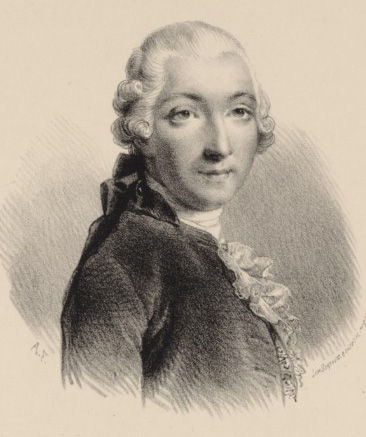
Illustration 2) Anonymous, ‘Maximilien Gardel’, Galerie des Maîtres et Chorégraphes (Paris: Bertauts, 1860), https://gallica.bnf.fr/ark:/12148/btv1b8420191s (accessed 19 May 2026).
Illustration 3) Eugène Charles François Guérard (del), and Emilien Desmaisons (lith), ‘L’Opéra – Mlle Guimard – La Pastorale’ (Paris: J. Bulla and F. Delarue, 1844), The New York Public Library Digital Collections, https://digitalcollections.nypl.org/items/d7e24d60-b6d6-0132-3db6-58d385a7bbd0 (accessed 19 May 2026).
Illustration 4) Anonymous, ‘Mademoiselle Heinel, the celebrated opera dancer’, [London, no pub., 1780-1789), The New York Public Library Digital Collections, https://digitalcollections.nypl.org/items/4821b0c0-18c3-0131-3103-58d385a7bbd0, (accessed 19 May 2026).
REFERENCES, Part I
[1] This set of three blog posts was originally a paper presented at EADH’s annual conference 2025 (Queen’s University Belfast) ‘Histories of European Dance behind the borders: Mobility, Influence, and Impact.’
[2] Gallica reveals the opéra comique (with new music by François Berton) was still in repertory in 1811: Ninette à la cour, opéra comique en 2 actes, paroles de MMrs Favart et C. remis au Théâtre de l'opéra Comique Impérial, le 21 Dec.bre 1811, avec une nouvelle musique (Paris: Mme Duhan, 1811), https://gallica.bnf.fr/ark:/12148/bpt6k11770579 (accessed 20 Oct. 2025).
[3] Vert-Vert, 2 sept. 1892, p. 2, https://www.retronews.fr/journal/vert-vert/02-septembre-1892/2/d61d65bb-936e-4471-bcae-15bcb81a2f8d (accessed 10 Nov. 2025).
[4] Ivor Guest, Ballet of the Enlightenment (London: Dance Books, 1996), p. 136.
[5] A search on ‘Querelle des Bouffons’ in openlibrary.org yields over 60 primary and secondary sources in French and English on the reception of these Italianate works in Paris circa 1755.
[6] ‘Gardel family’, International Encyclopedia of Dance, <www.oxfordreference.com> (accessed 18 May 2026).
[7] Guest, The Ballet of the Enlightenment, p. 117 and pp. 136-7.
[8] The Dublin performances are documented in John C. Greene, Theatre in Dublin, 1745-1820 : A Calendar of Performances (Bethlehem, PA: Lehigh University Press, 2011).
[9] See Ivor Guest, Appendix A ‘Ballets produced at the Paris Opéra, 1773-August 1793’, Ballet in the Enlightenment, pp. 418-20.
[10] Charles-Simon Favart and Maximilien Gardel, Programme du ballet de Ninette à la cour, représenté, à Versailles, devant Leurs Majestés, le 29 mai 1782, Paris: P.-R.-C. Ballard, [1782], p. 8, https://gallica.bnf.fr/ark:/12148/bpt6k146997b (accessed 18 May 2026).
[11] ‘Spectacles: Académie royale de musique’, Mercure de France, Sept. 1778, pp. 66-67, https://gallica.bnf.fr/ark:/12148/bpt6k3812044k (accessed 21 May 2026).
[12] According to Guest, the taunts are stimulated by her very awkward performance of a minuet at the command of the king. Guest, Ballet of the Enlightenment, p. 138.
[13] ‘Colas, de son côté, vole avec transport à sa chere Ninette qui ne veux point [l]’écouter’, Favart and Gardel, Programme, p. 16.
[14] As translated in Guest, Ballet of the Enlightenment, p. 139.
[15] For further on Guimard and her cultivation of celebrity, see Sarah McCleave, ‘The Celebrity Dancer Marie Madeleine Guimard’, Dance Biographies: Female theatrical Dancers circa 1680-1860, QUB Blogs Site, https://blogs.qub.ac.uk/dancebiographies/2023/01/29/the-celebrity-dancer-marie-madeleine-guimard/ (accessed 18 May 2026).
[16] Guest, Ballet of the Enlightenment, p. 197.
[17] Guest, Ballet of the Enlightenment, p. 141. I have not been able to verify the source of this anecdote.
[18] For a detailed study of this transmission see Tilden Russell and Dominique Bourassa, The Menuet de la cour, Terpsichore: Tanzhistorische Studien, Bd. 4, edited by Walter Salmen, Hildesheim, Zurich, New York: Georg Olms Verlag, 2007. For its origins as an opera dance to music by André-Ernest-Modeste Grétry and a likely dance notation by Malpied, see Moira Goff, ‘Le menuet de la cour’, Dance in History: Dance in Western Europe, from the 17th to the 19th century, https://danceinhistory.com/2019/02/18/le-menuet-de-la-cour/ (accessed 18 May 2026).
